python -m demo.plan_pytorch_model \
    --model bert --network 10Mbps/1ms
# on the server
cipherflow netbench --serve
# on the client
python -m demo.plan_pytorch_model \
    --model bert --ip SERVER_IP

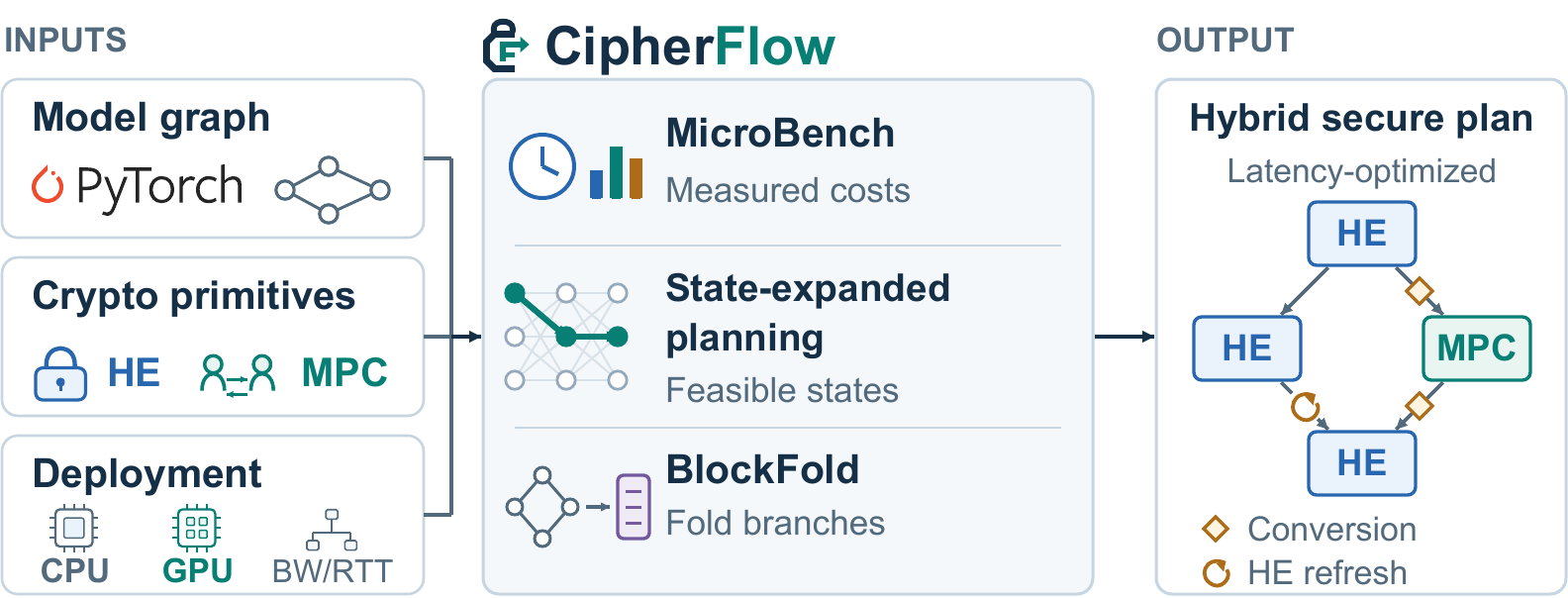
CipherFlow takes a high-level AI computation graph, available cryptographic primitives, and a target hardware and network configuration to construct a latency-optimized hybrid secure inference plan.
Programming usability. AI developers and data scientists express model computations while the compiler selects HE/MPC operators, conversions, state alignment, and ciphertext maintenance.
Execution efficiency. MicroBench profiles deployment costs; state-expanded planning jointly optimizes feasible execution decisions; and BlockFold scales planning across branched Transformer graphs.
 Interactive demoPlan BERT-base for your server and network
Plans by cipherflow.compile with the paper's profiles (HE: NEXUS; MPC: SHAFT, two parties and a trusted dealer). Latency is the whole 12-block model, estimated from measured costs.
speedup on BERT-base over state-of-the-art static hybrid placements (BumbleBee, BOLT, BLB)
speedup on ViT, measured on commodity CPU and GPU platforms in the NeurIPS 2026 evaluation
CipherFlow plans against an abstraction of the backends: methods, each one operator in one domain with the CKKS levels it consumes, the inputs it accepts and its measured cost. A library plugs in by registering its methods and a cost profile, or by declaring its primitives.
nn.Module, e.g. demo/transformer.py (BERT-base, ViT-B/16), traced by cf.models.from_torch into operators and residualscpu | gpu profile, or this machine (MicroBench)--network 10Mbps/1ms, or measured: --ip SERVER2pc | 2pc-dealerplan = cf.compile(graph, deployment, profile, calibration=None)
returns plan.json · plan.explain(steps=True) · plan.steps()
Every operator, conversion and bootstrap is timed on the target hardware, with its bytes and rounds, so the plan follows measured costs instead of a fixed rule.
Each operator's state is its domain and, in HE, the CKKS levels left. Placement, conversions and bootstraps become one shortest-path search over these states.
Each residual block is a single-entry, single-exit region. Folding it into one step contains the growth from branching joins and keeps planning tractable on Transformer-scale graphs.
Each backend reports its methods and the measured cost of every operator, conversion and bootstrap. CipherFlow plans with each pair of backends that fits the deployment and keeps the best plan.
cf.PrimitiveBackend; CipherFlow lowers every operator to them.Bring your own primitives →Choose how you install and what you want to plan. The commands follow your choices.
Plan a BERT-base encoder written in PyTorch and read the plan operator by operator: HE or MPC, the CKKS levels, the conversions and bootstraps before each operator, and where each operator is in the code.
python -m demo.plan_pytorch_model \
--model bert --network 10Mbps/1ms
# on the server cipherflow netbench --serve # on the client python -m demo.plan_pytorch_model \ --model bert --ip SERVER_IP
Run from the repository root, after installing from source.
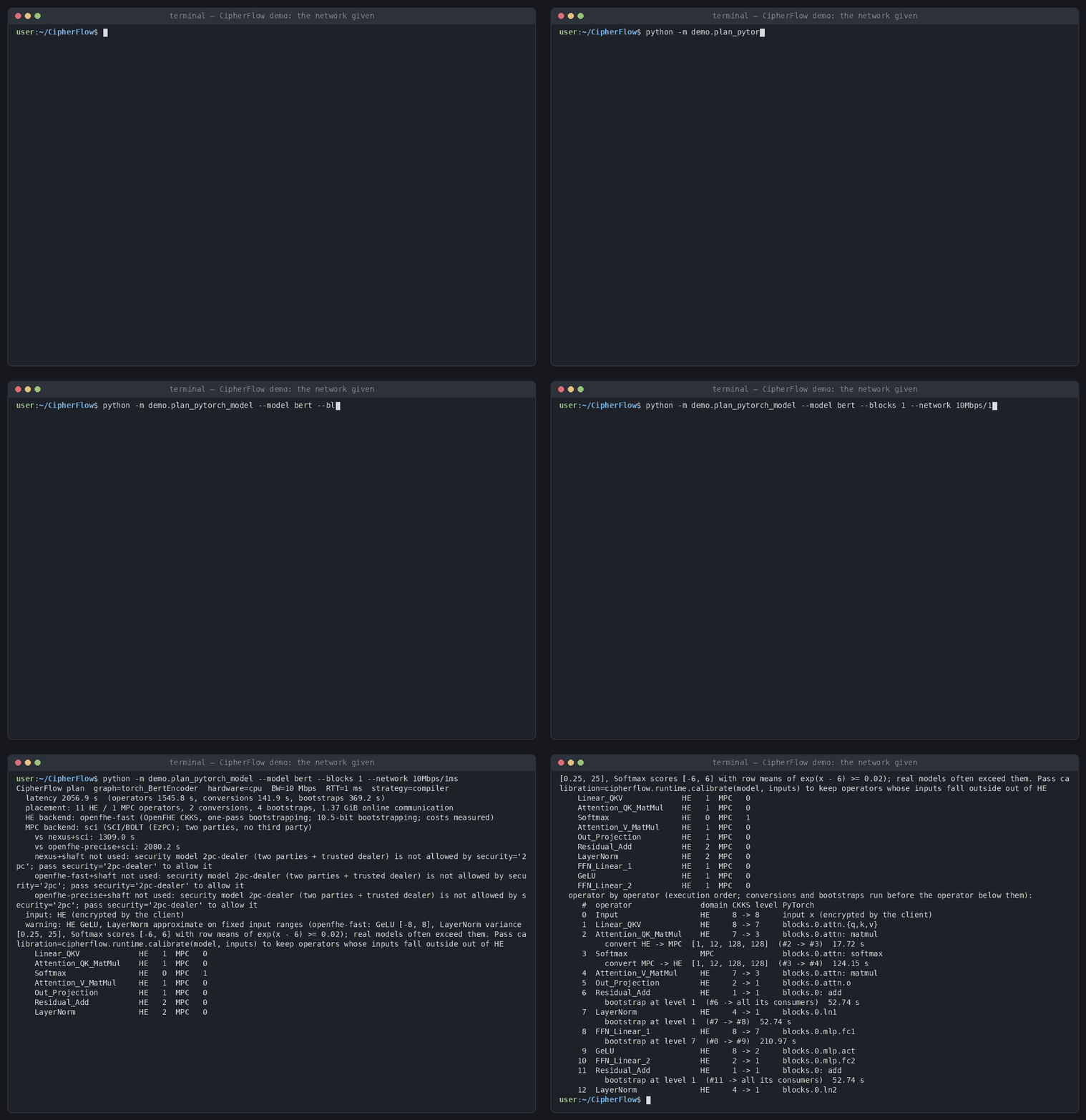
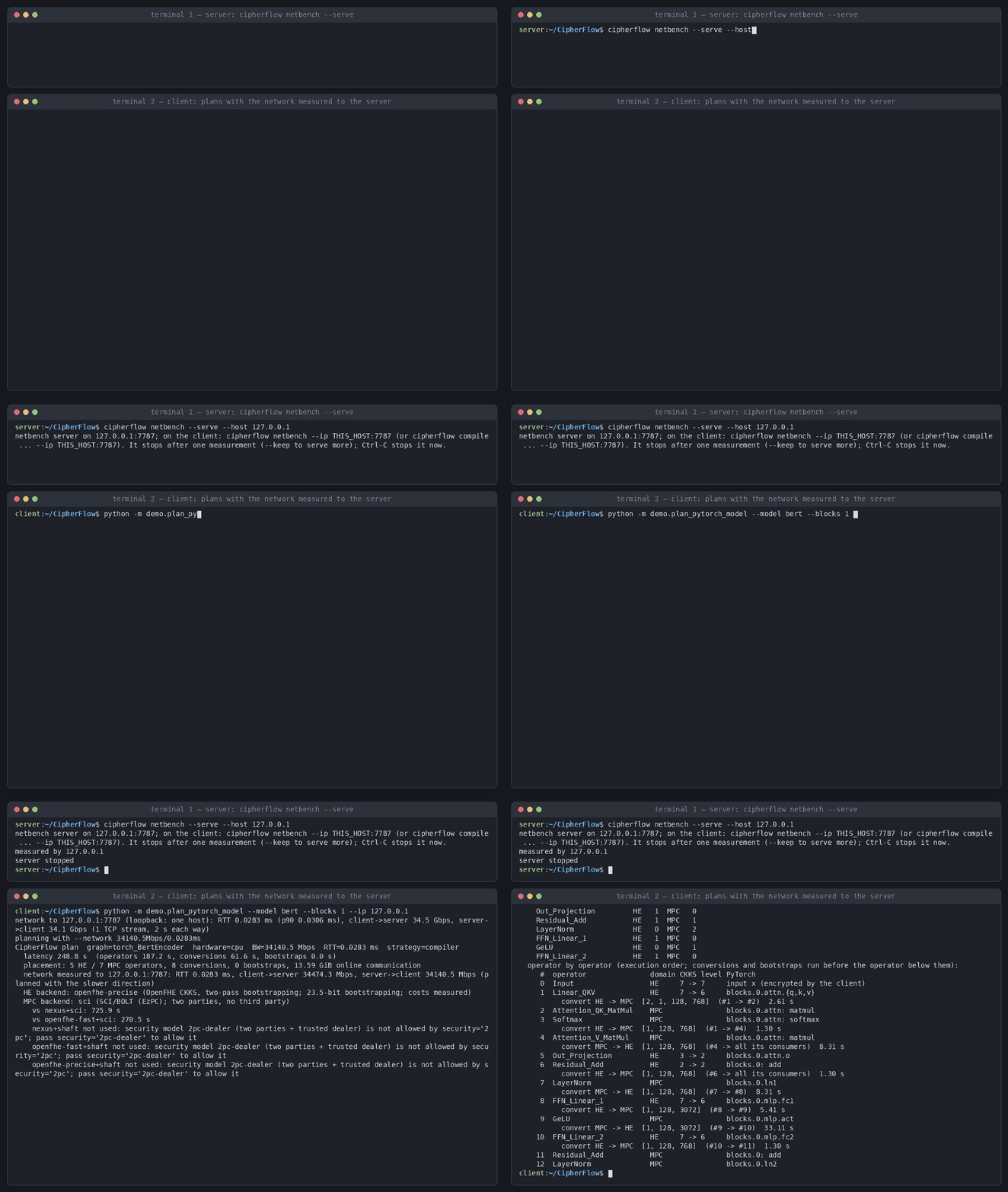
Two walkthroughs with real code and the output it prints. The first plans a BERT-base encoder step by step; the second brings kernels, primitives and applications of your own.
A plan says, for every operator, whether it runs in HE or MPC, how many CKKS levels it uses, and what converts or bootstraps before it. This tutorial plans the demo's BERT-base encoder. Install from source and run it from the repository root.
from_torch traces your encoder with torch.fx and maps it onto CipherFlow's operators: the Q/K/V projections, QKᵀ, Softmax, Attn·V, the linear layers, LayerNorm, GeLU and the residual adds. Each operator keeps its place in your code.
An operation outside this set raises cf.UnsupportedModel, which names each one.
import torch
import cipherflow as cf
from demo.transformer import bert   # BERT-base in plain PyTorch

encoder = bert()
graph = cf.models.from_torch(encoder, torch.zeros(1, 128, 768))
for node in graph.nodes[:4]:
    print(node.op_type, node.input_shape, node.attributes["source"])
Input (1, 128, 768) input x
Linear_QKV (1, 128, 768) blocks.0.attn.{q,k,v}
Attention_QK_MatMul (3, 1, 128, 768) blocks.0.attn: matmul
Softmax (1, 12, 128, 128) blocks.0.attn: softmaxA deployment is the server's hardware and the network between the client and the server. cpu and gpu select the built-in cost profiles. Give the network as bandwidth / round-trip time, or measure it with cipherflow netbench.
cf.match shows which HE and MPC backend pairs can plan the model there. The default security model, 2pc, allows two parties and no third party.
# hardware profile; network as bandwidth / round-trip time
deployment = cf.Deployment.of("cpu", "10Mbps/1ms")
print(cf.match(graph, deployment))   # HE + MPC pairs that fit
backends for torch_BertEncoder:
  nexus+sci              ok        30/30 cost entries exact; HE costs reference-scaled
  openfhe-fast+sci       ok        30/30 cost entries exact
  openfhe-precise+sci    ok        30/30 cost entries exact
  nexus+shaft            excluded  security model 2pc-dealer (two parties + trusted dealer) is not allowed by security='2pc'; pass security='2pc-dealer' to allow it
…compile plans the model with each backend pair that fits and keeps the best plan. It searches each operator's domain and CKKS level together, so it places conversions and bootstraps where they cost least.
plan.alternatives lists the other pairs and their latencies.
plan = cf.compile(graph, deployment)
print(plan.explain())
CipherFlow plan  graph=torch_BertEncoder  hardware=cpu  BW=10 Mbps  RTT=1 ms  strategy=compiler
  latency 25262.7 s  (operators 18549.8 s, conversions 1702.4 s, bootstraps 5010.5 s)
  placement: 132 HE / 12 MPC operators, 24 conversions, 59 bootstraps, 16.47 GiB online communication
  HE backend: openfhe-fast (OpenFHE CKKS, one-pass bootstrapping; 10.5-bit bootstrapping; costs measured)
  MPC backend: sci (SCI/BOLT (EzPC); two parties, no third party)
…explain(steps=True) lists the operators in execution order. Each row gives HE or MPC, the CKKS level before and after, and the line of your PyTorch code. The conversions and bootstraps that run before an operator sit above it.
Here Softmax runs in MPC, between two conversions, and everything else stays encrypted.
print(plan.explain(steps=True)) # operator domain CKKS level PyTorch
0 Input HE 8 -> 8 input x (encrypted by the client)
1 Linear_QKV HE 8 -> 7 blocks.0.attn.{q,k,v}
2 Attention_QK_MatMul HE 7 -> 3 blocks.0.attn: matmul
convert HE -> MPC [1, 12, 128, 128] (#2 -> #3) 17.72 s
3 Softmax MPC blocks.0.attn: softmax
convert MPC -> HE [1, 12, 128, 128] (#3 -> #4) 124.15 s
4 Attention_V_MatMul HE 7 -> 3 blocks.0.attn: matmul
5 Out_Projection HE 2 -> 1 blocks.0.attn.o
6 Residual_Add HE 1 -> 1 blocks.0: add
bootstrap at level 1 (#6 -> all its consumers) 52.74 s
7 LayerNorm HE 4 -> 1 blocks.0.ln1
bootstrap at level 1 (#7 -> #8) 52.74 s
8 FFN_Linear_1 HE 8 -> 7 blocks.0.mlp.fc1
bootstrap at level 7 (#8 -> #9) 210.97 s
9 GeLU HE 8 -> 2 blocks.0.mlp.act
…plan.json holds the whole plan for other tools. emulate runs the model in float64 with each operator in its planned domain: the HE kernels' approximations, fixed point in MPC, and each conversion's rounding. It runs at plaintext speed and does not run the cryptography.
Calibrate on real inputs with cf.runtime.calibrate, and pass the calibration to compile. Operators whose values fall outside an approximation then stay out of HE.
plan.to_json("plan.json")      # cipherflow explain plan.json --steps
x = torch.randn(1, 128, 768)   # hidden states of a real input
result = cf.runtime.emulate(plan, encoder, x)
print(result.summary())
output vs plaintext: max |err| 0.017, relative 0.00248
conversions 24, bootstraps 59 executed (plan: 24 / 59)
CipherFlow is not tied to the models and backends it ships with. Bring a faster kernel, a library's primitives, or an application with a step of its own; declare what one call costs, and the planner places it as it does the built-in ones. Each card shows the layer your code goes into. The examples continue the tutorial above: graph is BERT-base and deployment is a CPU server at 10 Mbps / 1 ms; each has a demo to run from the repository root.
python -m demo.extensions.new_he_primitive
ext = cf.Extension("my-he-softmax")
ext.primitive("Softmax", "HE",
              levels=4,                                    # CKKS levels one call consumes
              cost=cf.Cost(local_ms=31_000),               # one call on scores [1, 12, 128, 128]
              accepts=lambda node: None if node.input_shape[-1] == 128 else "rows of 128 scores only")

plan = cf.compile(graph, deployment, he="openfhe-fast", mpc="sci", extensions=[ext])
print(plan.explain(steps=True))
  latency 13676.2 s  (operators 6134.0 s, conversions 0.0 s, bootstraps 7542.1 s)
  placement: 144 HE / 0 MPC operators, 0 conversions, 83 bootstraps, 0.00 GiB online communication
…
     2  Attention_QK_MatMul     HE     7 -> 3     blocks.0.attn: matmul
          bootstrap at level 3  (#2 -> #3)  105.48 s
     3  Softmax [my-he-softmax] HE     8 -> 4     blocks.0.attn: softmax
          bootstrap at level 4  (#3 -> #4)  105.48 s
     4  Attention_V_MatMul      HE     7 -> 3     blocks.0.attn: matmul
…
Softmax now runs in HE, and the plan for BERT-base drops from 25,263 s to 13,676 s with no conversions left. The step table tags the operators your kernel runs.
python -m demo.extensions.primitive_backend
my_ckks = cf.PrimitiveBackend.he(
    "my-ckks", slots=32768, levels=10,
    bootstrap=cf.Cost(local_ms=9_000),                          # one ciphertext
    primitives={"add": cf.Cost(0.3), "mul_plain": cf.Cost(3),
                "mul": cf.Cost(40), "rotate": cf.Cost(35)})    # one call on one ciphertext
my_2pc = cf.PrimitiveBackend.mpc(
    "my-2pc",
    primitives={"mul": cf.Cost(3e-4, 128, 1),                   # per element: ms, bytes; rounds per call
                "matmul": cf.Cost(2e-5, 8, 2),
                "trunc": cf.Cost(2e-4, 128, 1),
                "cmp": cf.Cost(2e-3, 4000, 16)})

print(my_ckks.lower(graph))                                     # each operator as primitive calls
plan = cf.compile(graph, deployment, he="openfhe-fast", mpc="sci",
                  extensions=[my_ckks.extension(), my_2pc.extension()])
print(plan.explain())my-ckks (HE): every operator as primitive calls
Linear_QKV blocks.0.attn.{q,k,v} 53.93 s levels 1 [mul_plain 9,216, add 9,216, rotate 672]
BSGS diagonal matrix-vector product, 768 diagonals x 3 block(s)
Softmax blocks.0.attn: softmax 59.61 s levels 19 [mul_plain 12, mul 102, rotate 42, add 66, bootstrap 6]
exp by 8 squarings, row sums by rotation, 1/x by 4 Newton steps
…
latency 8435.3 s (operators 6185.5 s, conversions 8.8 s, bootstraps 2241.0 s)
placement: 143 HE / 1 MPC operators, 1 conversions, 59 bootstraps, 0.06 GiB online communicationEach operator becomes calls of your operations, with the CKKS levels they use and bootstraps inside a kernel that needs more levels than the budget. With these illustrative costs, the plan runs 143 operators on my-ckks and one LayerNorm on my-2pc.
python -m demo.extensions.private_rag_end_to_end --uncalibrated
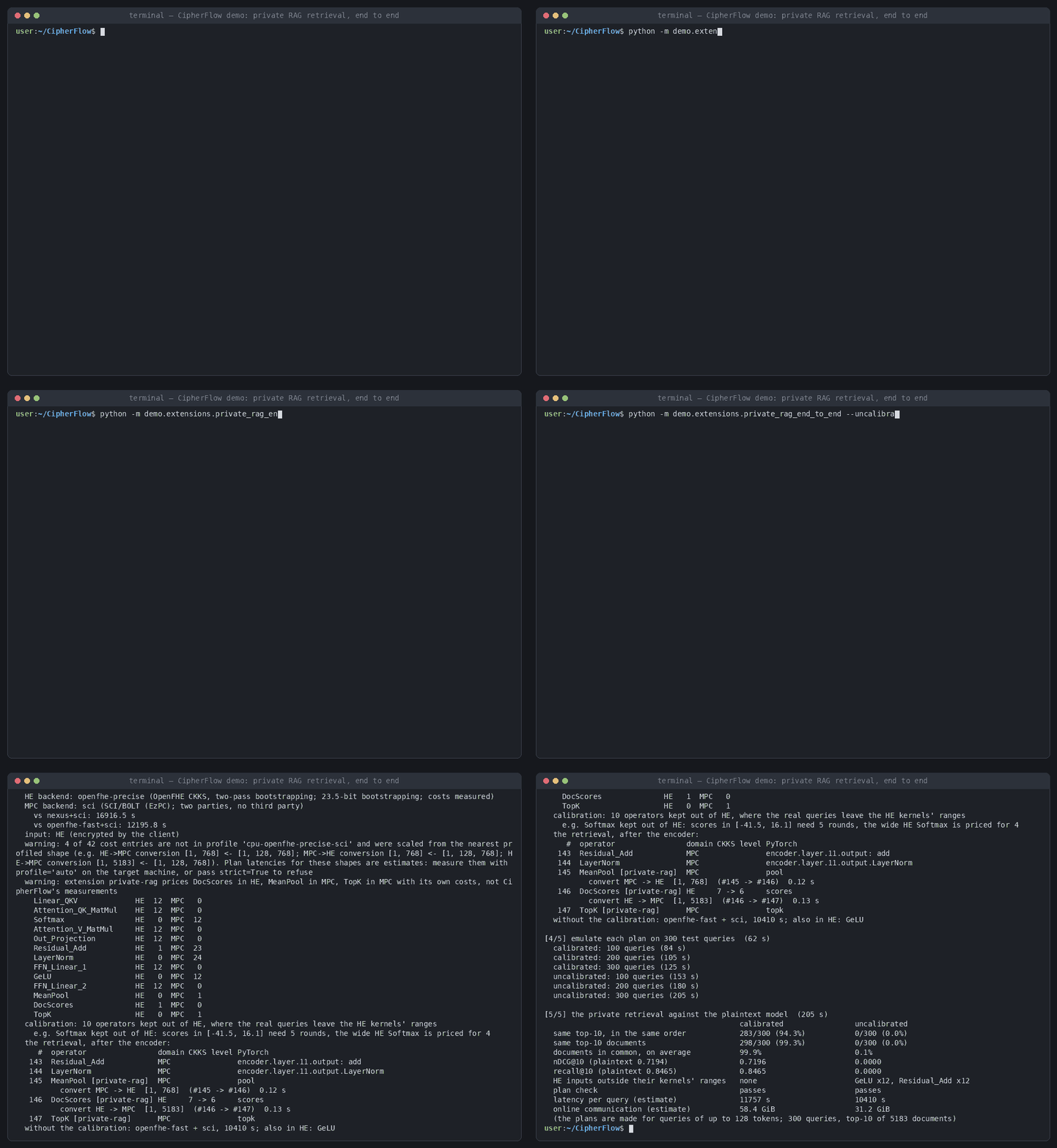
from demo.extensions.private_rag import MeanPool, DocScores, TopK, rag_extension

class Retriever(nn.Module):                   # the application: e5-base-v2's encoder, then the retrieval
    def __init__(self, encoder, docs, k):
        super().__init__()
        self.encoder, self.pool, self.scores, self.topk = encoder, MeanPool(), DocScores(docs), TopK(k)
    def forward(self, x):                     # x: the claim's token embeddings, from the client
        return self.topk(self.scores(self.pool(self.encoder(x)[0])))

rag = rag_extension()                         # the three operators, a kernel per domain, their costs
retriever = Retriever(e5.encoder, doc_embeddings, k=10)              # SciFact's 5,183 abstracts
graph = cf.models.from_torch(retriever, x, extensions=[rag])                     # 1. trace
cal   = cf.runtime.calibrate(retriever, training_claims, extensions=[rag])       # 2. calibrate
plan  = cf.compile(graph, cf.Deployment.of("cpu", "100Mbps/20ms"),
                   extensions=[rag], calibration=cal)                           # 3. compile
em    = cf.runtime.Emulator(plan, retriever, extensions=[rag])                   # 4. emulate: em(claim).output
                                            calibrated                uncalibrated
  same top-10, in the same order            283/300 (94.3%)           0/300 (0.0%)
  same top-10 documents                     298/300 (99.3%)           0/300 (0.0%)
  documents in common, on average           99.9%                     0.1%
  nDCG@10 (plaintext 0.7194)                0.7196                    0.0000
  recall@10 (plaintext 0.8465)              0.8465                    0.0000
  HE inputs outside their kernels' ranges   none                      GeLU x12, Residual_Add x12
  plan check                                passes                    passes
  latency per query (estimate)              11757 s                   10410 s
The retrieval's steps are PyTorch modules that CipherFlow traces as new operators: the document scores run in HE, the top-k in MPC. Calibrated on real claims, the private plan returns the plaintext model's top-10 for 298 of SciFact's 300 test claims. Planned without the calibration, HE GeLU leaves its range and the retrieval returns none of them. The demo needs transformers and datasets, and downloads e5-base-v2 and SciFact the first time.
Plans use the costs and levels you declare, as given. CipherFlow does not check an extension's correctness, precision or security, and does not execute extensions yet.
Read the full tutorial Limits on the roadmapBERT and ViT encoders are done. Generative models come next, first the backend operators decoders need and then the models; after them, a runtime that executes plans under encryption.
Hedong Zhang, Mengxin Zheng, and Qian Lou. CipherFlow: Compiling AI Programs for Efficient Cryptographically Secure Inference.
Read the paper · Download BibTeX
@inproceedings{zhang2026cipherflow,
  title     = {{CipherFlow}: Compiling {AI} Programs for Efficient Cryptographically Secure Inference},
  author    = {Zhang, Hedong and Zheng, Mengxin and Lou, Qian},
  booktitle = {Advances in Neural Information Processing Systems (NeurIPS)},
  year      = {2026},
  url       = {https://loopleap-lab.github.io/CipherFlow/assets/cipherflow-paper.pdf}
}